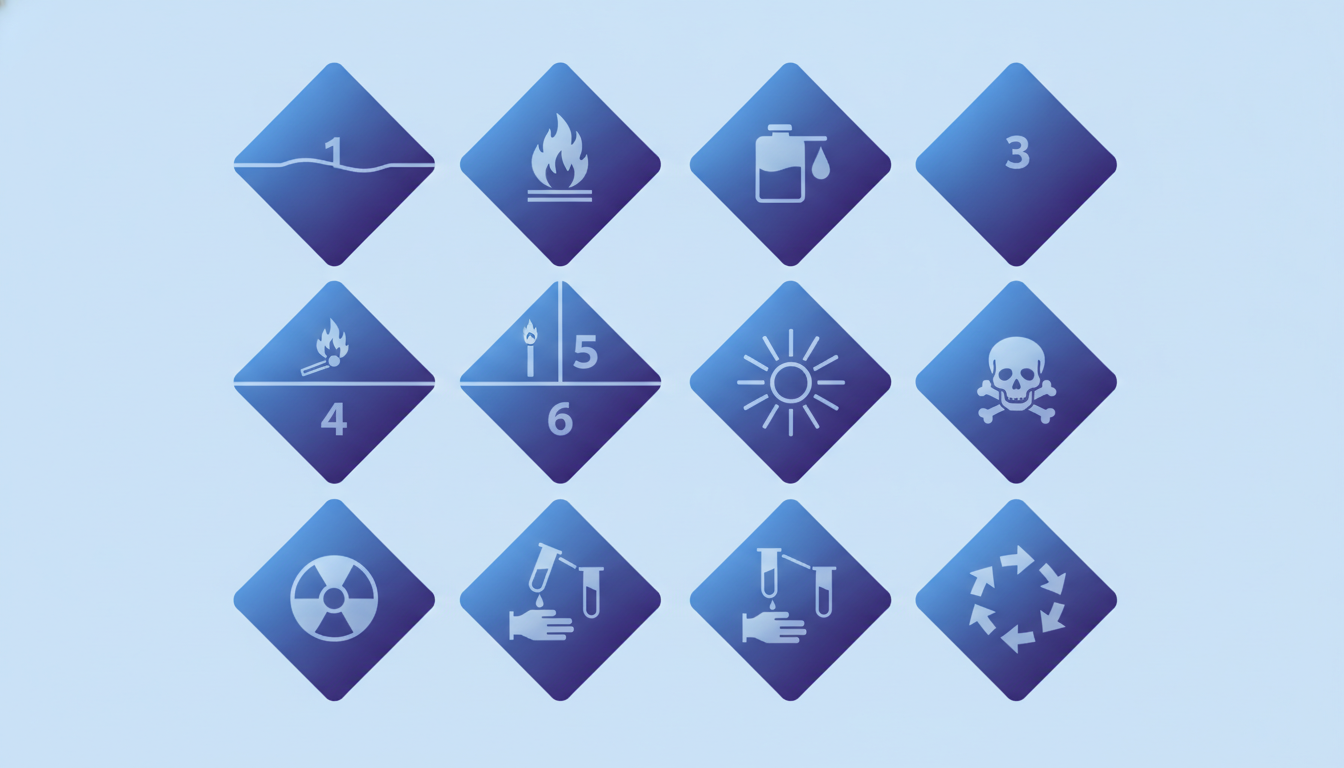
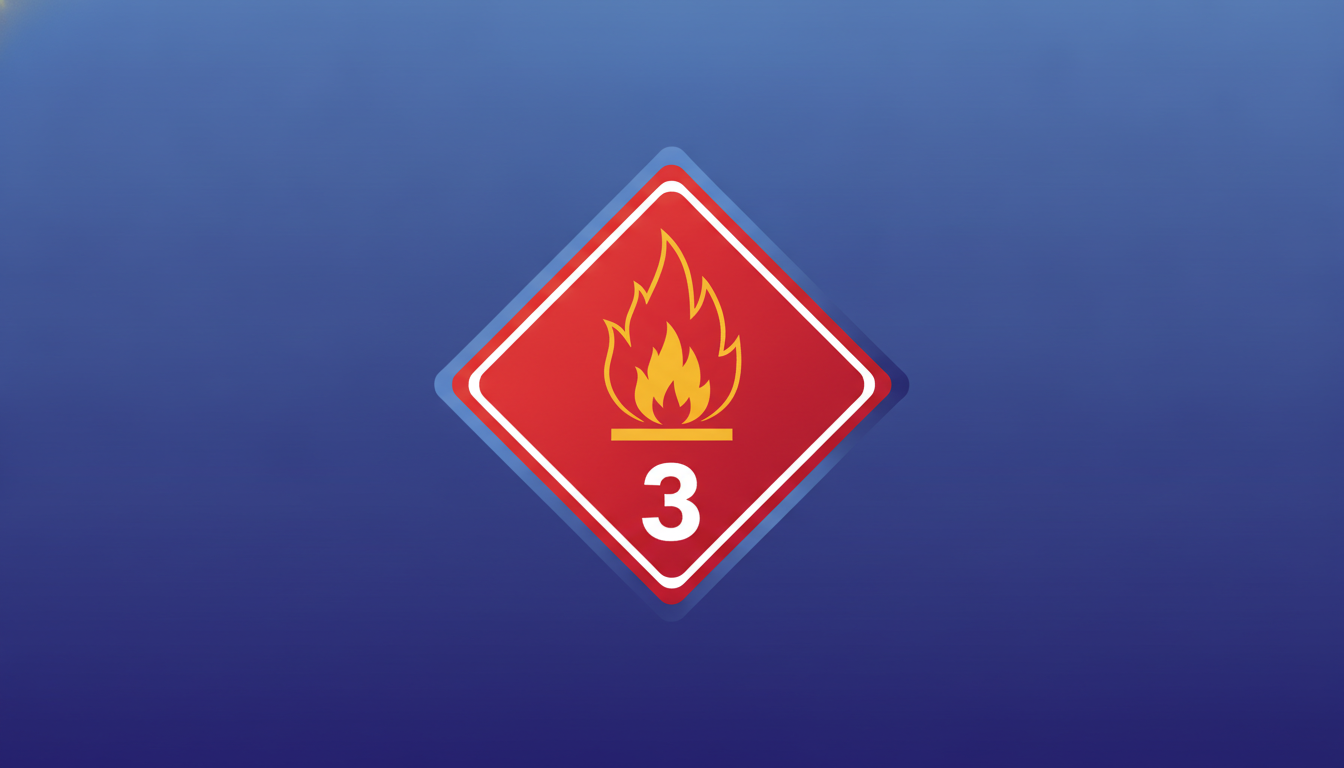
A hazmat label is a diamond-shaped (square-on-point) warning label required by the U.S. Department of Transportation under 49 CFR Part 172 Subpart E on packages containing hazardous materials offered for transport. Each label must measure at least 100 mm (3.9 inches) on each side, display the correct hazard class number, and use the specific color and symbol assigned to that class. Label Toolkit lets you design a correctly sized diamond label and export a print-ready PDF or ZPL file, though you must verify final compliance with your carrier and a qualified shipper or compliance officer.
DOT hazmat labels are diamond-shaped, minimum 100 mm per side, and class-specific in color and symbol.
There are 9 DOT hazard classes, several with sub-divisions, covering explosives through miscellaneous hazardous materials.
Labels apply to individual packages; placards (minimum 250 mm per side) apply to vehicles and freight containers once a threshold quantity is reached.
Label Toolkit can produce the correct size and shape; compliance verification with your carrier and a DOT-qualified person is mandatory before shipping.
What law governs hazmat labels in the United States?
The Hazardous Materials Regulations (HMR), codified at 49 CFR Parts 171 through 180, govern domestic and international transport of hazardous materials by road, rail, air, and water. Within the HMR, Subpart E of Part 172 (sections 172.400 through 172.450) sets out exactly which label to use, how big it must be, what colors and symbols it must carry, and where on the package it must appear.
Two other frameworks overlap in the broader hazardous materials space. The GHS/HazCom system (OSHA 29 CFR 1910.1200) governs workplace chemical labeling on containers in facilities. This article covers only the DOT transport labeling scheme. If you need workplace chemical labels, see our guide to GHS label requirements, elements, and pictograms.
The 9 DOT hazard classes and their labels
The DOT follows the United Nations transport classification system, organizing all hazardous materials into nine primary classes. The table below lists each class, its common label name, background color, and the identifying number that must appear at the bottom point of the diamond.
Class
Hazard type
Label name (common)
Primary background color
Class number at bottom point
1
Explosives
EXPLOSIVE 1.1 through 1.6 (by division)
Orange
1 (with division, e.g. 1.1)
2.1
Flammable gas
FLAMMABLE GAS
Red
2
2.2
Non-flammable, non-toxic gas
NON-FLAMMABLE GAS
Green
2
2.3
Toxic gas
POISON GAS / TOXIC GAS
White
2
3
Flammable liquid
FLAMMABLE LIQUID
Red
3
4.1
Flammable solid
FLAMMABLE SOLID
White with red stripes
4
4.2
Spontaneously combustible
SPONTANEOUSLY COMBUSTIBLE
White (top) / Red (bottom)
4
4.3
Dangerous when wet
DANGEROUS WHEN WET
Blue
4
5.1
Oxidizer
OXIDIZER
Yellow
5.1
5.2
Organic peroxide
ORGANIC PEROXIDE
Yellow (top) / Red (bottom)
5.2
6.1
Toxic material
POISON / TOXIC
White
6
6.2
Infectious substance
INFECTIOUS SUBSTANCE
White
6
7
Radioactive material
RADIOACTIVE I / II / III (by category)
White or Yellow
7
8
Corrosive material
CORROSIVE
White (top) / Black (bottom)
8
9
Miscellaneous hazardous material
CLASS 9 / MISCELLANEOUS
White with black stripes
9
Class 1 (Explosives) has six divisions (1.1 through 1.6) with different risk levels: division 1.1 covers mass explosion hazards; division 1.4 covers items with no significant blast hazard (such as consumer fireworks). Class 7 (Radioactive) has three label categories based on the transport index, a calculated number reflecting the radiation dose rate at one meter from the package surface.
Exact size and format requirements under 49 CFR 172.407
Section 172.407 is the measurement rule that trips up most first-time shippers. Here is what it actually requires:
Minimum side length: 100 mm (3.94 inches) on each of the four sides of the diamond square, measured from the outer edge of the solid or dotted border line.
Inner border line: A solid or dotted line must appear inside the diamond at least 5 mm (0.2 inches) from the outer edge. This creates the visible frame inside the shape.
Reduced size exception: If a package is too small to accommodate a 100 mm label, you may use a reduced-size label down to 50 mm per side, but only when the standard label cannot fit and you annotate the shipping papers accordingly.
Color: Colors must be as specified in the §172.411 through §172.448 label specifications. Printing on white or kraft paper is acceptable provided color contrast is maintained. Color fastness during transport conditions is required.
Symbol, text, and class number: The hazard symbol (flame, skull, etc.) must appear in the upper half of the diamond. The class or division number must appear in the lower corner point. Text such as "FLAMMABLE LIQUID" must appear in the lower half.
Orientation: The label must be square-on-point (rotated 45 degrees), not a horizontal rectangle.
For air transport, IATA Dangerous Goods Regulations impose additional requirements including a minimum 100 mm diamond and specific hatching patterns, so always check mode-specific rules if you ship by air.
Labels vs. placards: what is the difference?
Shippers often confuse labels and placards. The distinction is straightforward once you know the trigger.
Labels go on individual packages or overpacks and are always at least 100 mm per side. They are your responsibility as the shipper preparing the package.
Placards go on the outside of transport vehicles, freight containers, and unit load devices. They are larger: at least 250 mm (9.84 inches) per side. The carrier is primarily responsible for placarding the vehicle, but the shipper must provide the carrier with the required placard information and, in some cases, placards themselves.
The threshold that triggers placarding on a highway vehicle is generally 1,001 pounds (454 kg) aggregate gross weight of all regulated hazardous materials in non-bulk packages, or any quantity of certain extremely hazardous materials (like Division 1.1 explosives or Class 2.3 toxic gases). Below that threshold, labels on the packages suffice; placards are still recommended but not mandatory for some classes. 49 CFR 172.504 defines the full table of placard thresholds.
Where on the package must the label appear?
Under 49 CFR 172.406, the label must be:
Displayed on the same surface of the package as the proper shipping name and UN identification number markings, when practicable.
Not placed on a seam or closure where it would be obscured when the package is sealed.
Placed near the marked proper shipping name when both appear on the same surface.
Not covered by other labels, overstickers, or attachments that obscure the hazard information.
If a package must carry more than one class label (for example, a flammable liquid that is also toxic), all required labels must appear on the same surface side-by-side.
Which carrier requirements go beyond the federal minimum?
Federal DOT rules set the floor, but major carriers layer on additional specifications. Here is a comparison of common carrier requirements as of 2024:
Carrier / mode
Governing document
Notable additions beyond 49 CFR
UPS Ground / Air
UPS Tariff and Hazmat Guide
Prior approval required for many hazmat classes; specific packaging certifications; shipper ID number on label in some cases
FedEx Ground / Express
FedEx Dangerous Goods Service Guide
Category A infectious substances not accepted; shipper must use FedEx-approved packaging for Class 7; lithium battery labels must include watt-hour ratings
USPS
USPS Publication 52
Many hazmat classes are prohibited outright; flammable liquids restricted by quantity; no Class 1 explosives except consumer commodity ORM-D equivalents
IATA (air)
IATA DGR current edition
Orientation arrows required on liquids; "CARGO AIRCRAFT ONLY" label for certain quantities; shipper's declaration for dangerous goods document required
IMDG (ocean freight)
IMDG Code current amendment
Marine pollutant mark required separately; stowage categories affect labeling documentation
Always check the current version of your carrier's dangerous goods guide before tendering a hazmat shipment. Guides update annually or more frequently.
Special cases: lithium batteries, ORM-D, and limited quantity marks
Lithium battery labels
Lithium ion and lithium metal batteries (Class 9) shipped under 49 CFR 173.185 require a specific lithium battery mark (not the standard Class 9 diamond) showing the UN number and watt-hour or lithium content rating. This mark is 120 mm wide by 110 mm tall, with a black border and a battery graphic. It is separate from, and sometimes in addition to, the standard Class 9 label.
ORM-D (Other Regulated Materials for Domestic transport)
The ORM-D designation was phased out by the DOT Pipeline and Hazardous Materials Safety Administration (PHMSA) effective January 1, 2021. Consumer commodities formerly marked ORM-D must now use the "Limited Quantity" mark or proper hazmat labels depending on quantity and mode. If you still see ORM-D marks in your operation, they are out of compliance.
Limited quantity (LQ) marks
Small quantities of certain hazardous materials shipped under the Limited Quantity exception (49 CFR 173.150 through 173.156) do not require the full diamond label. Instead, they require the UN Limited Quantity mark: a black square-on-point with a white center. The outer diamond is black; the inner square is white; no class number is shown. This mark is at least 100 mm per side for highway transport. Limited Quantity exceptions have strict per-inner-package and per-outer-package quantity limits that vary by material.
How to design a DOT hazmat label with Label Toolkit
Label Toolkit handles the geometric precision that hazmat diamond labels demand. The steps below cover designing a Class 3 Flammable Liquid label as a practical example.
Open the designer and set canvas dimensions. Create a new label and set the width and height to 110 mm by 110 mm. The extra 5 mm per side gives bleed room beyond the 100 mm minimum edge-to-edge diamond size required by 172.407. Use mm units throughout to match the regulatory specification exactly.
Draw the outer diamond shape. Insert a square shape element, set it to 100 mm by 100 mm, and rotate it 45 degrees. Set the fill to the class color (Class 3: red, approximately #CC0000). Set stroke to none.
Add the inner border line. Duplicate the shape, reduce it to 90 mm by 90 mm (5 mm inset on each side), set fill to none, and set stroke to black at 1 mm width. This satisfies the inner border line requirement.
Place the hazard symbol. Upload an SVG of the flame symbol (available from PHMSA's official label specifications or public domain UN symbol sets) and position it in the upper half of the diamond.
Add the class text. Insert a text element reading "FLAMMABLE LIQUID" in the lower half. Font should be a clean sans-serif such as Helvetica or Arial Bold at approximately 8 pt minimum for a 100 mm diamond (172.407 does not set a minimum point size but legibility is required).
Add the class number. Insert "3" at the bottom point of the diamond, centered, in black text. Minimum height of the class number per 172.407 is 6.3 mm for a full-size 100 mm label.
Export as vector PDF. Use Label Toolkit's true vector PDF label export so the diamond shape prints at exactly 100 mm regardless of the printer's native DPI. Send to a color thermal transfer printer or a commercial printer for best results.
Verify before use. Measure the printed label with a ruler. Confirm colors match the PHMSA specification. Have a DOT-qualified person or your carrier review the full label set before the first shipment.
Printing considerations for hazmat labels
Hazmat labels must remain legible and color-stable throughout the transport journey. That means:
Direct thermal printing fades with heat and moisture; use thermal transfer with a resin or wax-resin ribbon for outdoor or temperature-variable shipping environments. See our direct thermal vs thermal transfer comparison for the full tradeoffs.
Print at 300 DPI (12 dpmm) or higher for clean symbol edges. At 203 DPI (8 dpmm) the flame or skull graphic can appear jagged at 100 mm scale.
Use label stock rated for the temperature range the package will experience. Refrigerated pharmaceutical hazmat shipments, for example, may require cryogenic-rated polyester stock.
Colors must not bleed or fade when exposed to moisture per 49 CFR 172.407(d). Inkjet-printed labels on plain paper typically fail this requirement in transit.
When do you need a "Hazardous Materials" marking vs. a hazmat label?
Labels and markings serve different functions in the DOT system. A marking is text or a symbol that describes the contents (the proper shipping name, UN number, net quantity, etc.). A label is the diamond that communicates the hazard class visually. Both are required on most regulated packages. The proper shipping name and four-digit UN number (for example, UN 1203 for gasoline) must appear on the package separate from, though typically adjacent to, the diamond label.
Common mistakes that cause non-compliance
Using a label that is 4 inches (101.6 mm) per side measured to the outer tip of the diamond point, rather than 100 mm measured along the side. The 100 mm requirement is a side measurement, not tip-to-tip.
Printing on a color laser printer without verifying color calibration. PHMSA color specifications are defined in the regulation; if your red prints as orange, the label is non-compliant.
Forgetting to apply all required labels when a material has multiple hazards. A flammable, toxic liquid may need both a Class 3 and a Class 6.1 diamond.
Using old ORM-D labels after the January 2021 phase-out deadline.
Applying a Limited Quantity mark when the quantity in the package exceeds the LQ exception threshold for that specific UN number, sending the package into full hazmat regulation.
Not updating labels when a carrier changes its dangerous goods guide (most carriers update annually).
How this differs from GHS/HazCom labeling
The GHS (Globally Harmonized System for Classification and Labelling of Chemicals) label that OSHA requires under HazCom 2012 sits on containers in your workplace, warehouse, or retail environment. It uses similar diamond pictograms (flame, skull, corrosion), but its purpose is to protect workers handling the substance, not to communicate transport hazard class to carriers and emergency responders.
DOT transport labels and GHS workplace labels can look superficially similar, but they have different regulatory authority, different mandatory elements, and different size rules. A GHS label alone is not sufficient for DOT transport compliance, and a DOT transport label alone does not satisfy OSHA HazCom requirements. Many shippers need both.
For the full GHS picture, our GHS label requirements guide covers the six mandatory elements, all nine GHS pictograms, and free templates. For the broader landscape of compliance label types, the label requirements and compliance category covers food, GHS, DOT, candle labeling, and more in one place.
Frequently asked questions
What is the minimum size for a DOT hazmat label?
The minimum is 100 mm (3.94 inches) on each side of the diamond, as required by 49 CFR 172.407(b). A reduced size of 50 mm per side is permitted only when the package is too small to accommodate the standard size and the shipping papers note the reduction.
Do I need a hazmat label for lithium batteries in a laptop?
It depends on quantity and shipping mode. A single laptop shipped as a consumer product often qualifies for the Section 185 exception and needs only the lithium battery mark (not the full Class 9 diamond). Pallets of batteries or bulk shipments typically require full Class 9 labeling plus carrier pre-approval. Check 49 CFR 173.185 and your carrier's lithium battery guide for the thresholds that apply to your shipment.
Can I print DOT hazmat labels at home or in my office?
Yes, but the label must meet all specification requirements: correct size, accurate colors, durable materials, and legible symbols. Inkjet-printed paper labels often fail the moisture-resistance requirement in practice. A thermal transfer printer with a color ribbon on polyester or polypropylene stock is a more reliable choice for labels that will be in transit.
What is the difference between a hazmat label and a placard?
Labels go on individual packages and must be at least 100 mm per side. Placards go on transport vehicles and freight containers and must be at least 250 mm per side. Placarding is triggered by quantity thresholds defined in 49 CFR 172.504; below those thresholds, package labels alone are required for most hazard classes.
Does Label Toolkit produce DOT-compliant hazmat labels?
Label Toolkit gives you the precise canvas sizing, vector shape tools, and PDF export needed to create a geometrically correct 100 mm diamond label. The tool does not validate regulatory compliance automatically; you are responsible for verifying that colors, symbols, text, and class numbers match the 49 CFR Part 172 specifications and your carrier's requirements before you use the labels on actual shipments.
Ready to design your hazmat labels at the exact dimensions DOT requires? Create a free Label Toolkit account and open the designer in your browser right now, no install needed.