Food label requirements in the US are governed by the FDA under 21 CFR Part 101 and the Food Safety Modernization Act. Every packaged food sold in interstate commerce must carry eight mandatory elements: a statement of identity, net quantity of contents, Nutrition Facts panel, ingredient list, allergen declaration, manufacturer or distributor name and address, country of origin where applicable, and required handling statements. Label Toolkit gives you a free, browser-based canvas to design, proof, and print all of these without installing software.
Eight elements are mandatory under 21 CFR 101; missing any one can trigger an FDA warning letter or product detention at the border.
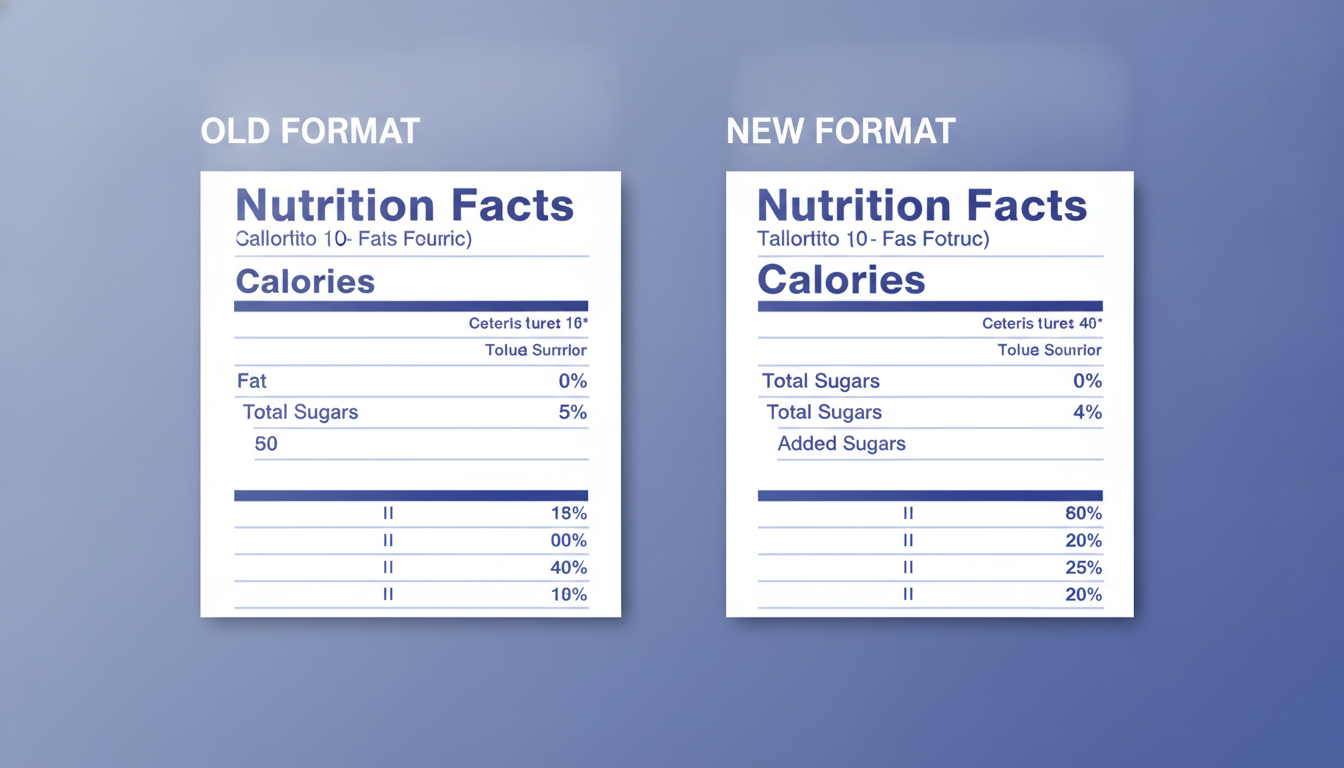
The Nutrition Facts panel format changed in 2020, adding a larger calorie display and an "Added Sugars" line, and those updates are now fully enforced for all manufacturers.
Major food allergens must be declared either in the ingredient list or in a separate "Contains" statement immediately after it, per FALCPA and the FASTER Act of 2021, which added sesame as the ninth allergen effective January 1, 2023.
Label Toolkit's compliance templates let you build a print-ready label that meets FDA placement and type-size rules, then export to PDF or Zebra ZPL, free.
What federal laws govern food labeling in the US?
Three statutes do most of the work. The Federal Food, Drug, and Cosmetic Act (FD&C Act) is the foundation: it prohibits misbranded food and defines what information must appear. The Nutrition Labeling and Education Act of 1990 (NLEA) mandated the Nutrition Facts panel. The Food Allergen Labeling and Consumer Protection Act of 2004 (FALCPA) required plain-language allergen statements, and the FASTER Act of 2021 added sesame as the ninth major allergen, effective January 1, 2023.
Regulations implementing those statutes live in Title 21 of the Code of Federal Regulations. Part 101 covers general food labeling, Part 102 covers common or usual names, and Part 105 addresses foods for special dietary use. FSMA (signed 2011, with rolling compliance dates through the 2020s) added requirements around facility registration and preventive controls but did not rewrite the core label elements in Part 101.
The eight mandatory elements on a US food label
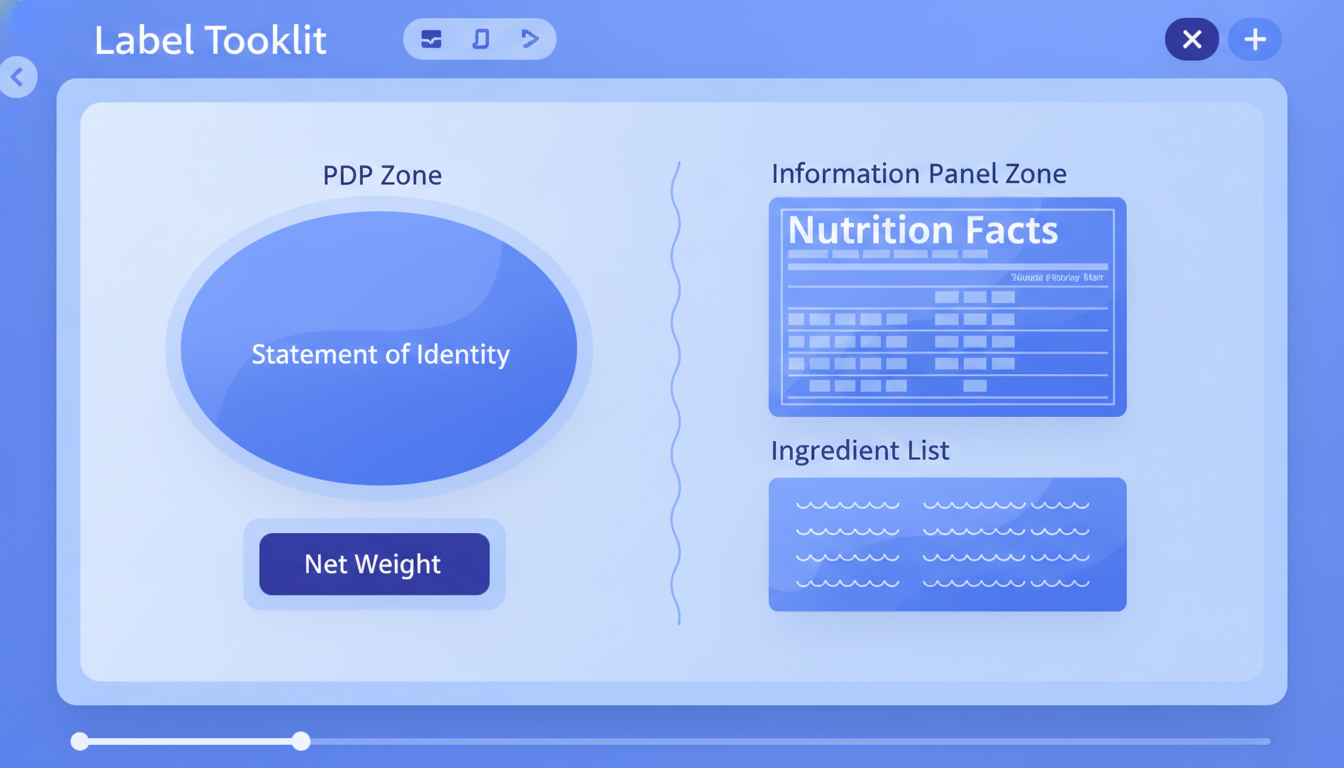
The table below maps each required element to its regulatory home and the physical location on the label where the FDA expects to find it. The "principal display panel" (PDP) is the part of the label most likely to be displayed to the consumer at the point of sale. The "information panel" is the panel immediately to the right of the PDP when facing the consumer.
Element
Regulatory citation
Required panel
Key details
Statement of identity
21 CFR 101.3
PDP
Common name of the food in bold or prominent type, parallel to the base of the package
Net quantity of contents
21 CFR 101.7
PDP, lower 30%
Weight, volume, or count; dual declaration required for most solid or semi-solid foods (e.g., "NET WT 12 OZ (340 g)")
Mandatory for certain commodities (fish, shellfish, meat, fresh produce); voluntary but must be truthful if stated for most packaged goods
Handling or storage statements
21 CFR 101.17
Prominent location
Required when safety depends on storage, e.g., "KEEP REFRIGERATED" or "KEEP FROZEN"
How does the Nutrition Facts panel work?
The Nutrition Facts panel is the most visually regulated element on any food label. The FDA specifies not just what nutrients to list but the exact type sizes, column widths, and line weights. Here is what the 2020 format requires:
Serving size: Must reflect amounts people actually eat, based on Reference Amounts Customarily Consumed (RACCs) defined in 21 CFR 101.12. The calories figure must appear in larger, bold type, at least 16-point for most packages.
Calories: Declared in large bold type. For packages containing more than one serving but that could reasonably be consumed in a single sitting, a dual-column format shows both per-serving and per-container values.
Nutrients required: Total fat, saturated fat, trans fat, cholesterol, sodium, total carbohydrate, dietary fiber, total sugars, added sugars (new in 2020), protein, vitamin D, calcium, iron, and potassium. Vitamins A and C are no longer mandatory but may be declared voluntarily.
Daily Values (DVs): Updated in 2020. Sodium DV is now 2,300 mg (down from 2,400 mg). Potassium DV is 4,700 mg.
Footnote: Must read: "The % Daily Value (DV) tells you how much a nutrient in a serving of food contributes to a daily diet. 2,000 calories a day is used for general nutrition advice."
Small businesses (under $10 million in annual food sales) had until January 1, 2021 to comply. All manufacturers have been required to use the updated format since then.
What is the ingredient list rule?
Under 21 CFR 101.4, ingredients must be listed by their common or usual name in descending order of predominance by weight, measured before cooking. "Enriched flour (wheat flour, niacin, reduced iron, thiamine mononitrate, riboflavin, folic acid)" is a typical example: the main ingredient is listed first, and sub-ingredients appear in parentheses. Water counts as an ingredient if added; spices, flavors, and colors have specific naming rules.
If your product contains a multi-ingredient component, you have two options. List the composite ingredient by its common name followed by a parenthetical breakdown, or list each component individually in their proper weight order within the overall list. Either is compliant; consistency matters more than the choice.
How must allergens be declared?
FALCPA and the FASTER Act require that each of the nine major food allergens be declared in plain English. There are two compliant methods:
Within the ingredient list: Use the common name of the allergen either as the ingredient name itself ("milk") or in parentheses after an uncommon name ("sodium caseinate (milk)").
"Contains" statement: Place a "Contains" statement immediately after the ingredient list, for example: "Contains: Wheat, Milk, Sesame." If you use this method, the statement must list every allergen present in the product.
Voluntary precautionary statements such as "May contain traces of peanuts" are not regulated by FALCPA and do not satisfy the mandatory allergen declaration. They may appear on the label in addition to the required declaration but never as a substitute for it.
Sesame became the ninth major allergen on January 1, 2023. Labels designed before that date need review. The FDA has published FALCPA guidance with worked examples and common questions.
What are the type-size and placement rules?
Placement and legibility rules in 21 CFR 101 are more specific than most small manufacturers expect:
Net quantity of contents must appear in the bottom 30% of the PDP, in type proportional to the PDP area. For a PDP of 5 square inches or less, the minimum type height is 1/16 inch (about 4.5 pt). For a PDP of 5 to 25 square inches, the minimum is 1/8 inch (about 9 pt).
Statement of identity must be in type at least half the point size of the largest type on the PDP, and the type must be reasonably bold.
Nutrition Facts panel minimum type size for most text is 6 points. The FDA provides graphic standards in its Nutrition Facts label guide.
All mandatory label text must appear in English, though a second language may be added. If the label is in a foreign language only, all mandatory elements must also appear in English.
Are there exemptions from full Nutrition Facts labeling?
Yes. Several categories of food are exempt from the standard Nutrition Facts format or from nutrition labeling entirely:
Raw fruits, vegetables, and fish are subject to voluntary nutrition labeling guidelines rather than mandatory panel requirements, though retailers are encouraged to display information at the point of sale.
Small businesses with fewer than 100 full-time employees and fewer than 100,000 units sold per year may qualify for an exemption under 21 CFR 101.9(j)(18), provided no nutrition claims are made on the label.
Restaurant and similar retail food establishments are generally exempt, though menu labeling rules under section 4205 of the ACA apply to chains with 20 or more locations.
Single-ingredient products with no added nutrients (e.g., plain bottled water, some spices) may be exempt, but the product still must carry a statement of identity, net quantity, and manufacturer information.
What about organic, non-GMO, and other voluntary claims?
Voluntary claims appear on millions of food labels but carry their own regulatory obligations. "USDA Organic" certification is managed by the USDA National Organic Program (NOP), not the FDA, and misuse of the seal is a federal violation. "Non-GMO" is voluntary and unregulated by the FDA at the federal level, though USDA's National Bioengineered Food Disclosure Standard (NBFDS) requires a disclosure statement or symbol for food containing bioengineered ingredients sold after January 1, 2022. Health claims and nutrient content claims (e.g., "low sodium" or "good source of fiber") are regulated under 21 CFR Parts 101.13 and 101.54 through 101.80, and each claim has defined criteria the product must meet before the claim can appear.
How do you design a compliant food label in Label Toolkit?
Label Toolkit runs entirely in the browser, so there is nothing to install. The steps below walk through building a basic compliant product label:
Open the Label Toolkit designer and choose your label size. Common food label sizes include 2 x 3.5 inches (small jar labels), 3 x 5 inches, and 4 x 6 inches for larger packages.
Add your statement of identity as a text element on the principal display panel zone. Set the font to bold and size it to at least half the point size of the largest text on that panel.
Add the net quantity of contents text element in the lower 30% of the PDP. Use the dual declaration format: ounces first, grams in parentheses, e.g., "NET WT 4 OZ (113 g)".
Use the nutrition label template in Label Toolkit to add a pre-formatted Nutrition Facts block on the information panel. The template follows the 2020 FDA format with the enlarged calorie display and the Added Sugars line already in place.
Add your ingredient list and allergen declaration as a text block below the Nutrition Facts panel. Keep type at 6 points minimum.
Add the manufacturer name and address block. If you are the distributor rather than the manufacturer, use the phrase "Distributed by" followed by your company name and full address.
Export to PDF using Label Toolkit's true vector PDF export, which preserves crisp text at any print size, or export ZPL directly if you are printing to a Zebra thermal printer.
Common mistakes that trigger FDA warning letters
The FDA publishes warning letters publicly, and patterns emerge quickly when you read through them. The most common food label violations include:
Declaring a nutrient content claim (e.g., "high protein") without meeting the regulatory definition for that claim under 21 CFR 101.54.
Listing serving sizes smaller than the applicable RACC in order to make calories appear lower.
Omitting added sugars from the Nutrition Facts panel on products that contain syrups, honey, or concentrated fruit juice.
Using a "Contains" statement that omits one or more major allergens present in the product.
Printing the net quantity in the wrong location or in type too small for the PDP area.
Making a health claim that is not an authorized claim under 21 CFR 101.70 through 101.83.
How does this relate to the broader label compliance picture?
Food label requirements are one part of a wider compliance landscape that includes GHS chemical labels, CE marking, UKCA declarations, and shipping label standards. For a broader view of which label types carry mandatory regulatory requirements and how to manage them across industries, see the guide to label requirements and compliance covering the full pillar of regulatory label types that Label Toolkit supports.
Frequently asked questions
Do I need a Nutrition Facts panel on every food product I sell?
Most packaged foods sold in the US require a Nutrition Facts panel. The main exemptions are raw fruits, vegetables, and fish (covered by voluntary guidelines), very small businesses meeting the criteria in 21 CFR 101.9(j)(18), and certain single-ingredient foods with no added nutrients. If you make any nutrition or health claims on your packaging, the exemptions no longer apply and a panel is required.
What are the nine major food allergens in the US?
As of January 1, 2023, the nine major food allergens under federal law are milk, eggs, fish, shellfish (e.g., shrimp, crab, lobster), tree nuts (e.g., almonds, walnuts, pecans), peanuts, wheat, soybeans, and sesame. Sesame was added by the FASTER Act of 2021 and became effective in 2023.
What is the difference between the PDP and the information panel on a food label?
The principal display panel (PDP) is the face of the package most likely seen by a shopper at the point of sale; it must carry the statement of identity and net quantity. The information panel is immediately to the right of the PDP, and it is where the Nutrition Facts panel, ingredient list, allergen declaration, and manufacturer information must appear unless they fit on the PDP.
Can I print food labels on a thermal printer?
Yes. Thermal printers are widely used for food labels, especially in small-batch, local, and private-label production. Direct thermal labels are economical but can fade with heat or moisture; thermal transfer labels printed with a resin or wax-resin ribbon are more durable for refrigerated or frozen products. Label Toolkit exports both print-ready PDF files and Zebra ZPL code, so you can print on any compatible thermal printer.
Does a "best by" or expiration date count as a mandatory label element?
For most foods, date labeling is voluntary under federal law. There is no single FDA regulation that mandates a "best by" or expiration date on packaged food (infant formula and certain meal-replacement products are exceptions). Several states have additional date-labeling requirements, so always check state law for your distribution area.
Ready to build a compliant food label? Create a free Label Toolkit account and open the nutrition label template in the designer. No download, no subscription required to get started.